12 Best AI Art Generators in 2026: The Future of Art Is AI-Powered
A practical, up-to-date guide to the AI art tools creative professionals actually use in 2026
Nexovah Staff
23d ago · 10 min read
Key Takeaways
- Midjourney V7 remains the artistic-quality leader in 2026, prized for its distinctive lighting, composition, and color grading.
- DALL-E 3 wins on prompt accuracy and legible in-image text, and comes bundled with ChatGPT Plus.
- Flux (Black Forest Labs) matches Midjourney-level photorealism at a fraction of the cost as an open-weights model.
- Stable Diffusion offers maximum control for technical users who want local generation and full customization.
- Ideogram leads the field for text-in-image and logo-style generation, a weak spot for most other tools.
AI Art Has Moved From Novelty to Professional Tool
AI art generators have gone from a curiosity to a genuine part of the creative workflow — used for concept art, marketing visuals, product mockups, and social content. The models behind them have improved sharply too: what took a rough, obviously-AI-generated image in 2022 now produces outputs indistinguishable from professional photography or illustration.
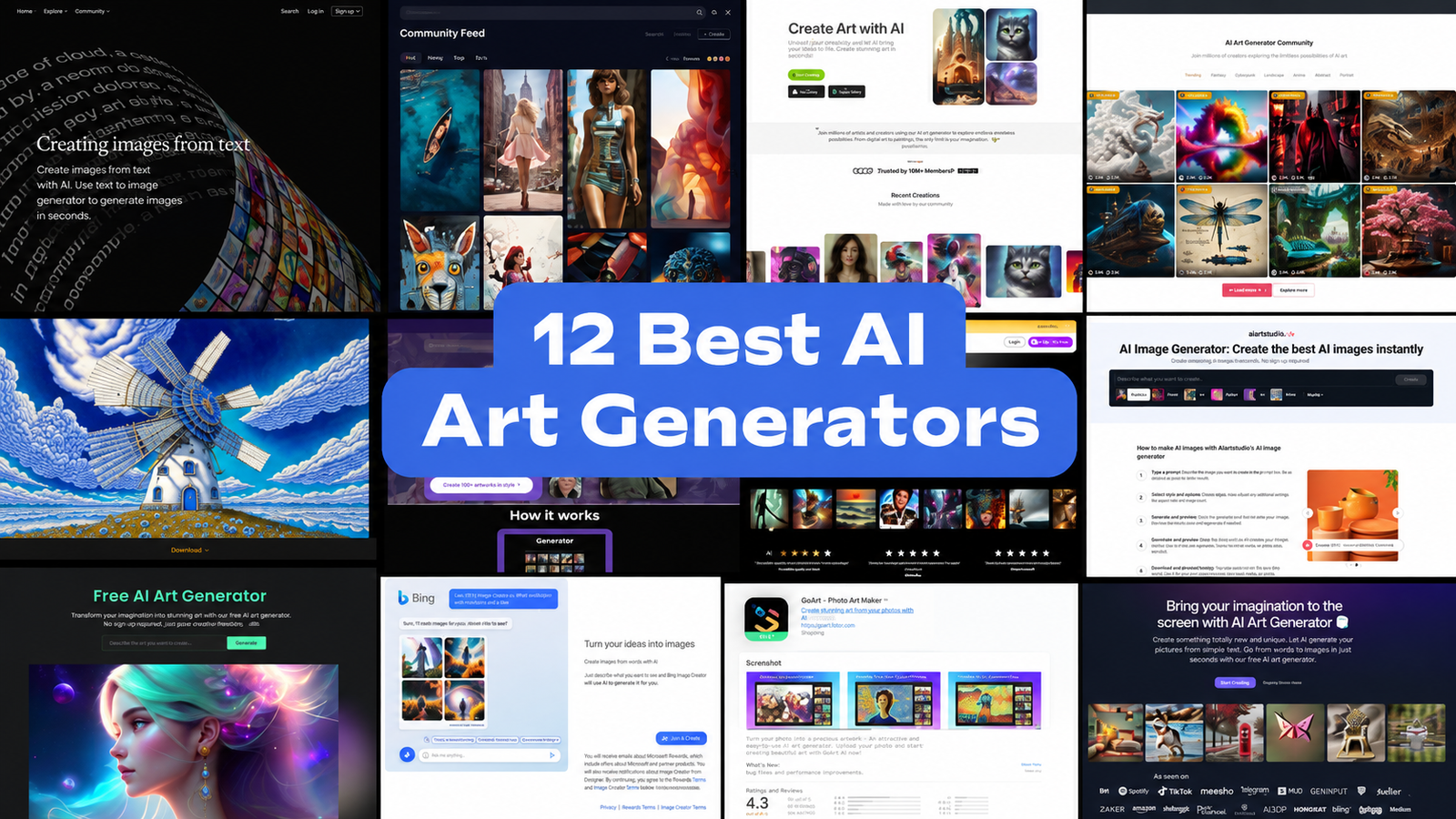
Below are 12 of the strongest AI art generators available in 2026, what each one is actually good at, and how to think about picking between them.
Midjourney remains distinctly ahead on default aesthetics — lighting, composition, and color grading that other tools only reach with heavy prompt engineering.
1. DALL-E 3
DALL-E 3, integrated directly into ChatGPT, remains the easiest entry point into AI art. Its core strength is correctness — it follows complex, multi-part instructions faithfully and renders legible text inside images better than almost any competitor.
If you're already paying for ChatGPT Plus, DALL-E 3 is included at no extra cost, making it the most frictionless option for quick, accurate generations without learning a separate tool.
2. Midjourney V7
Midjourney continues to set the bar for artistic quality. V7 produces a recognizable, painterly aesthetic that creators specifically seek out for stylized, emotionally resonant work — illustration, concept art, and anything where mood matters more than literal accuracy.
It runs via Discord or its own web app, with subscription tiers from roughly $10 to $60/month depending on generation volume and commercial usage rights.
3. Flux (Black Forest Labs)
Flux has become one of the most talked-about additions to the space — an open-weights model that matches Midjourney-level photorealism at a fraction of the cost. For teams that need volume without a heavy subscription bill, Flux is now a serious default choice.
4. Stable Diffusion
Stable Diffusion remains the tool of choice for technically inclined users who want full control — custom checkpoints, fine-tuned models, and local generation with no per-image cost once set up. It has the steepest learning curve of any tool on this list, but nothing else offers the same depth of customization.
If you need to generate thousands of images or train a model on a specific style, Stable Diffusion is unbeatable — just budget time for the setup and learning curve.
5. Ideogram
Ideogram has carved out a clear niche as the best tool for text-in-image and logo-style work — a category where most AI art generators historically struggled, often producing garbled or illegible lettering.
6. Shutterstock AI Image Generator
Shutterstock's built-in generator offers a straightforward way to produce commercially licensed images without leaving a familiar stock-photo workflow. It's slower to generate than most dedicated AI art tools, but the ethical training-data sourcing and direct licensing make it a safer default for commercial and enterprise use.
7. PhotoSonic
PhotoSonic uses a text-to-image model tuned for both artistic and realistic output, with straightforward controls over style and quality — a solid fit for blog visuals and quick product shoot mockups.
8. Fotor AI Art Generator
Fotor pairs AI generation with a full photo-editing suite, letting you generate an image and immediately adjust size, effects, and composition in the same interface. Its artwork library keeps every past generation accessible for reuse.
9. Bing Image Creator
Bing Image Creator, powered by DALL-E, remains a genuinely free option for casual use — no subscription required, just a Microsoft account. It generates square-format images and lacks advanced editing tools, but it's a reliable choice for quick personal projects.
10. NightCafe
NightCafe combines generation with a genuine community — daily challenges, a public gallery, and prompt sharing that helps newcomers learn faster by studying what works for other creators.
11. Jasper Art
Built by the team behind the Jasper AI copywriting platform, Jasper Art is aimed squarely at marketing teams that need copyright-cleared visuals to pair with AI-generated copy — useful for anyone already inside the Jasper ecosystem.
12. Starryai
Starryai focuses on accessibility and community, with a large base of active creators sharing prompts and styles. It's a good entry point for anyone new to AI art who wants to learn from an existing community rather than starting from a blank prompt box.
Quick Comparison: Which Tool Fits Your Workflow
| Tool | Best For |
|---|---|
| Midjourney V7 | Artistic quality, stylized visuals |
| DALL-E 3 | Prompt accuracy, in-image text, beginners |
| Flux | Photorealism at low cost, open-weights |
| Stable Diffusion | Full control, local generation, technical users |
| Ideogram | Logos, typography, text-in-image |
Where AI Art Generation Is Headed
The gap between AI-generated and professionally produced visuals has effectively closed for most commercial use cases. The real decision in 2026 isn't whether to use AI art tools — it's which one matches your specific need: Midjourney for mood and style, DALL-E 3 for accuracy, Flux for cost-efficient photorealism, Stable Diffusion for full control, and Ideogram when the image needs to carry real text.
FAQ
Midjourney V7 remains the artistic-quality leader, with a distinctive aesthetic in lighting, composition, and color grading that other tools typically only match with heavy prompt engineering.
Published in The Nexovah Blog
Written by Nexovah Staff